



 Chernivtsi region,
  +38 (050) 50 50 103
 Mon.-Fri.: 08:00-20:00,
Since 1958, when Jackson JP biomechanical offered direction in the treatment of gonarthrosis corrective osteotomy of the tibia, developed many kinds tibial osteotomy as well as hip bones. The purpose of osteotomies is to normalize the load on the joint surfaces, restore the ability to function, thereby reducing the progression of the degenerative-dystrophic process in the joint.
The possibility of reducing the progression of osteoarthritis is indicated by histologically confirmed facts of cartilage formation in the areas of the defect of the cartilage of the processes of the femur and tibia after undergoing corrective osteomies. The positive effect of osteotomy is confirmed by the reduction of intra-bone pressure and the restoration of microcirculation.
Osteotomies are divided into two types - angular (wedge-shaped and bone-shaped) and arched. V-shaped osteotomy is a combination of both.
Corrective osteotomy is performed to correct deformities of the lower extremities, it is well proven as a technique that gives excellent cosmetic result, as well as as an alternative to knee joint replacement.
More than 45000 corrective osteotomies are performed annually in Europe. This surgery is particularly effective for young patients with O-or X-shaped limb deformity or initial signs of knee arthrosis. At deformation of the lower extremity there is a shift of the mechanical axis of loading on a knee joint, thus articular cartilage is loaded unevenly, there is its overload and destruction, leading to early development of an arthrosis and strengthening of deformity of a limb. Corrective osteotomy can eliminate O-or X-shaped deformation, restore the mechanical axis of the limb and thus normalize the load on the knee joint. A timely osteotomy prevents the destruction of articular cartilage and the progression of arthrosis.
In patients with advanced knee arthrosis, this surgery can significantly delay knee replacement. This is especially important for young patients who lead active lifestyles, as endoprosthesis requires a dramatic change in lifestyle (limiting load on the joint, exclusion of sports, regular observation by an orthopedist, exclusion of overheating and hypothermia, etc.). It should also be noted that whatever perfect knee joint prosthetics are, they have a limited life span, and the placement of the endoprosthesis at a young age involves repeated surgery to replace worn components or the entire endoprosthesis. Therefore, in European countries, it is decided that young patients undergo corrective osteotomies rather than endoprosthetics.
Corrective osteotomy is performed as follows: due to a small incision, the tibia in the upper third or the femur in the lower third is partially crossed (osteotomized), deformity is corrected and the osteotomy area is fixed in the correct position by the modern fixation. Osteotomy zone enlargement usually occurs in 10-12 weeks. Sports loads are possible 6 months after surgery.
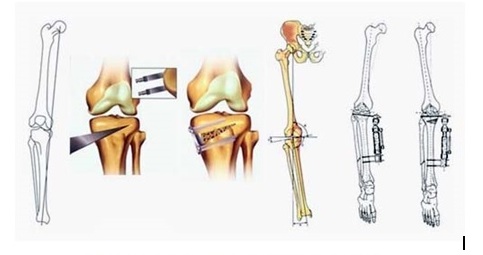
Indications for corrective osteomy:
- congenital deformity of the lower extremities;
- deformation after illness (rickets, Paget's disease, etc.);
- deformity after impaired growth of the extremities (Blount's disease, damage to the growth areas in traumas, etc.);
- deformations after irregular splicing in traumas (post-traumatic deformities);
- arthrosis of one component (lateral or medial divisions) of the knee joint;
- compensation for the instability of the knee joint apparatus.
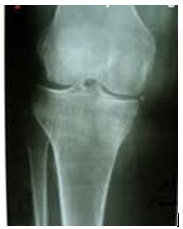
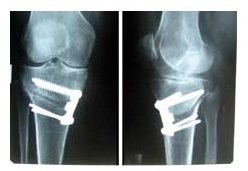
Clinical example.
Deforming osteoarthritis of the knee joint against the background of viral deformity
To achieve a good postoperative result, a high proximal osteotomy should be combined with other interventions aimed at eliminating other morphological (such as cartilage or meniscus damage) or functional (eg instability) disorders in the knee.
| Врач | Имя | Специализация | Время приема (воскресенье) |
|---|---|---|---|
 |
Білик Сергій Вікторович | Травматология и ортопедия | - |